
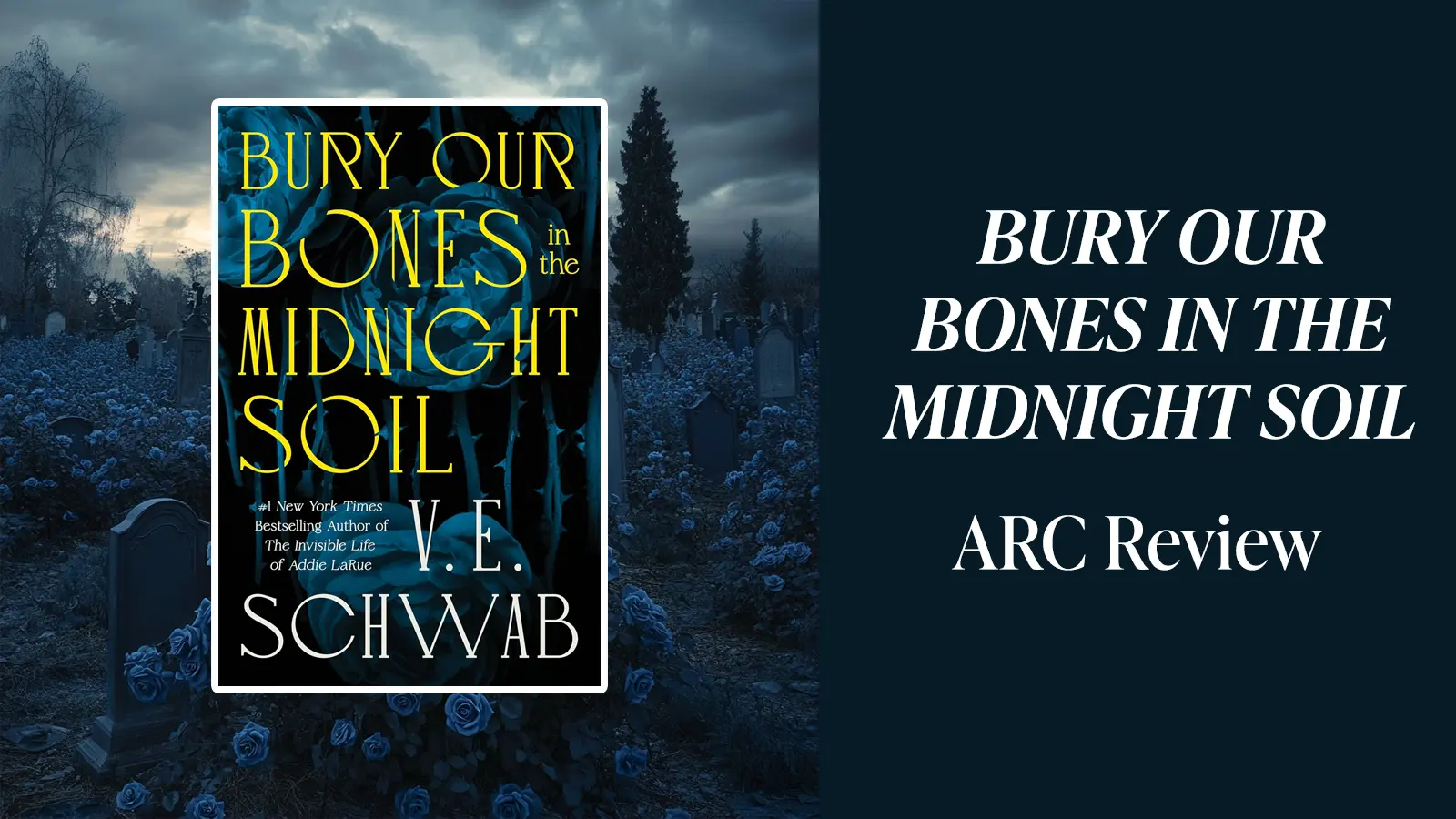

I received an advance reader copy of Bury Our Bones in the Midnight Soil by V.E. Schwab from NetGalley and Tor Publishing Group in exchange for an honest review. All thoughts and opinions are my own.
For those who romanticize the haunted and the undead, and love so bathed in blood that nobody can let go, this one’s for you. If you’re into a gothic fever dream drowning in grief, yearning, and toxic situationships that stretch across centuries, Bury Our Bones in the Midnight Soil by V.E. Schwab might be for you.
This poetically haunting novel follows three women across three timelines, weaving a lyrical tale of love, loss, and the toll eternal existence takes on the soul.
I’ve heard many great things about V.E. Schwab, namely The Invisible Life of Addie LaRue, and I was itching to read her work. As a lifelong vampire lore obsessive, I’m so glad Bury Our Bones was my entry point. Read on for my full ARC review.
Bury Our Bones in the Midnight Soil

Description
From V. E. Schwab, the #1 New York Times bestselling author of The Invisible Life of Addie LaRue: a new genre-defying novel about immortality and hunger.
This is a story about hunger.
1532. Santo Domingo de la Calzada.
A young girl grows up wild and wily—her beauty is only outmatched by her dreams of escape. But María knows she can only ever be a prize, or a pawn, in the games played by men. When an alluring stranger offers an alternate path, María makes a desperate choice. She vows to have no regrets.
This is a story about love.
1827. London.
A young woman lives an idyllic but cloistered life on her family’s estate, until a moment of forbidden intimacy sees her shipped off to London. Charlotte’s tender heart and seemingly impossible wishes are swept away by an invitation from a beautiful widow—but the price of freedom is higher than she could have imagined.
This is a story about rage.
2019. Boston.
College was supposed to be her chance to be someone new. That’s why Alice moved halfway across the world, leaving her old life behind. But after an out-of-character one-night stand leaves her questioning her past, her present, and her future, Alice throws herself into the hunt for answers . . . and revenge.
This is a story about life—
how it ends, and how it starts.
Summary
06/11 Update: Bury Our Bones Under the Midnight Soil is now out, and I hope you all are enjoying it! In case the jumping timelines are confusing, here’s a linear version of the events in this wonderful story — although I strongly recommend you read the full story before catching up on the summary on this page!
I’ve broken the story up in linear pieces, but obviously as the centuries goes on the characters will show up in each others’ story lines, so keep on reading!
Who was your favorite vampire lead in Bury Our Bones in the Midnight Soil?
Who was your favorite vampire lead in Bury Our Bones in the Midnight Soil?
Maria’s Story
Maria is a young woman living in 16th-century Spain with beautiful copper-colored hair and a hunger like no other. She wants big things for herself, bigger than the life she’s been dealt, which she knows can only be accomplished by marrying up. So Maria uses her beautiful looks to get the attention of a nobleman, a viscount named Andrés. The viscount thinks it’s his idea to court Maria, but it was Maria who manipulated him into their courtship. Eventually, Maria marries the viscount, becoming his viscountess, and the two of them depart for his estate.
Maria and Andrés travel to his estate as husband and wife. It becomes clear that Andrés sees his wife only as a vessel for breeding. Maria, however, has no interest in having a child. She takes herbs and potions to prevent becoming pregnant.
They fall into a regular cadence of life in the Olivares estate. Maria wants to be free, but in this world, the only way for a woman to be free is by becoming a widow. She remembers seeing a widow when she was younger, a woman so beautiful and utterly free. Maria begins spending time with her maid Ysabel, with whom she develops a romantic affection that confuses and unnerves her.
Andrés begins restraining Maria’s movements. He treats her like a kept princess. Maria isn’t allowed to wander the estate or the yard.
Andrés continues sleeping with her, but when Maria asks about her own desires, he treats it as blasphemy and sees sex only as an act for procreation. His parents arrive, and though his mother-in-law is full of piety and tradition, she clearly doesn’t like Maria.
War comes, and Andrés is called to the front. Maria, as a married woman, cannot stay alone in the estate, so Andrés sends her to live with his parents. Maria is bored out of her mind, feeling suffocated and restless under the thumb of her overbearing mother-in-law. Andrés comes and goes from the war, but Maria doesn’t conceive.
One day, she sees a figure from the past in the town square, the widow from her childhood. Maria is shocked to see she hasn’t aged a day, although Maria herself has aged ten years. She finds out the widow, Sabine, runs an apothecary. Maria makes up an excuse to visit her, pretending she’s seeking a fertility potion.
Sabine and Maria begin spending a lot of time together. Maria is envious of Sabine’s freedom. Sabine gives her tonics to prevent pregnancy and eventually teaches her how to make potions herself. The two become close, and Maria develops deeper feelings for Sabine.
Sabine tells Maria that when she is ready to claim what she wants, she’ll be waiting.
Eventually, Andrés becomes suspicious of how much time they spend together. One night, Maria sneaks out to see Sabine, ready to leave her old life behind. Sabine asks if she’s ready to be free. Maria says yes.
Sabine then bites Maria’s throat, revealing that she’s a vampire, the secret to her eternal youth. Maria is frightened at first, but not for long, as Sabine drains her blood. Sabine offers her own blood in return, and Maria drinks. But greedy as ever, Maria drinks too much, killing Sabine in the process.
Maria returns to the estate and kills her husband and his family. She burns the estate to the ground and moves on, adopting the name Sabine herself, leaving Maria behind.
Sabine’s Story
Leaving Maria’s name and memory behind, Sabine begins traveling the world. She’s constantly hungry, the sun hurts her, and she cannot satisfy her bloodlust. She roams Spain, drinking from everyone in sight. Over time, she develops a taste for women’s blood rather than men’s, and starts hunting women exclusively.
After spending countless weeks, months, and years alone, she runs into Hector and Renata, two vampires traveling the world together. Renata is instantly drawn to Sabine. They tell her they’ve procured a boat and invite her to join them, which Sabine does.
They begin traveling from port to port, Renata and Hector teaching her how to live as a vampire. She learns that grave dirt and burial grounds harm her, and that if her heart is stabbed or pierced, she can die. She also discovers that vampires can hear thoughts, especially those of humans and younger vampires.
The three of them travel together across Europe for fifteen years, killing, hunting, and drinking their fill. Sabine and Renata eventually grow close and become lovers. Sabine worries Hector will care, but he’s old and is Renata’s maker, so he doesn’t mind when she drifts. Their bond is stronger than blood.
One year, Hector decides he will only drink from men of faith. Renata and Hector had warned Sabine that although vampires are immortal, they are not meant to live forever. Eventually, their minds begin to rot and they become obsessed with the hunt. Hector starts showing signs of this unhinged degeneration.
After Hector hunts in a church, they are noticed. Renata and Hector are caught and burned in coffins.
Sabine flees to Venice. There she meets Matteo, a very old vampire who has claimed Venice as his own. He allows Sabine to stay, but only if she follows his rules. He begins teaching her how to hunt with purpose instead of feeding indiscriminately. She learns to enjoy the hunt as much as the feeding. He also teaches her how to claim territory using her mind.
Matteo has a human lover, Alessandro, an artist whom Sabine grows to care for. She spends decades with them, though Alessandro never allows Matteo to turn him. Sabine learns to savor the process, going weeks without feeding, and realizes she can no longer enjoy feeding unless it is earned through the thrill of the hunt.
Alessandro grows old and dies, leaving Matteo drowning in grief. Sabine tries to help him, but Matteo sinks deeper. He eventually turns a mortal companion, who dies due to Matteo’s impulsiveness. Grief-stricken and unstable, Matteo boards a boat for America and asks Sabine to come with him. She declines.
Sabine wanders Europe alone for decades. In the 1800s, she arrives in London, where she discovers the debutante season. Pretending to be a widow, she ingratiates herself into London society. She decides to hunt one of the new debutantes and attends a ball, where she meets Charlotte.
Charlotte’s Story
Charlotte is a countryside girl from Britain in the 1800s. She and her best friend Jocelyn become intimate while running through the fields, only to be caught by Charlotte’s brother, James. In response, Charlotte is sent to London to learn etiquette and find a husband.
Charlotte longs to be free, to read books, wander the halls of her family’s estate, and spend her days in the sun. At her first ball, she meets a beautiful woman with bright copper hair, the widow Sabine. Charlotte realizes Sabine is adored by everyone and is free precisely because she is a widow.
The two begin spending time together and become close friends. Charlotte catches the attention of society while also developing feelings for Sabine. Their friendship remains cordial, but they regularly spend time alone. Sabine, having marked Charlotte as her next hunt, begins manipulating her the same way the original Sabine manipulated Maria. She taunts Charlotte with the freedom she could have.
One day, Charlotte receives a letter from Jocelyn announcing that she and James are getting married. Charlotte is devastated. She spends the night playing cards with Sabine, the two of them growing even closer. Sabine tells Charlotte that when she knows what she wants, she should go after it.
Later that season, a gentleman Charlotte danced with a few times professes his love and asks her to marry him. Charlotte, wanting nothing to do with marriage, runs to Sabine ready to claim her as a lover. Sabine has other plans and turns Charlotte into a vampire.
Charlotte and Sabine become a couple, although Charlotte is riddled with guilt every time she has to take a life. Sabine, who has never had qualms about killing, begins to grow tired of Charlotte’s hesitation. Still, they stay together for centuries, falling deeply in love despite their differences.
Sabine grows possessive, wanting all of Charlotte’s love for herself. Charlotte becomes isolated, never allowed to meet other vampires. Sabine becomes jealous whenever Charlotte asks about others. When they run into two vampires, Jack and Antonia, Charlotte is thrilled, but Sabine grows increasingly hostile. They fight, then reconcile. Sabine makes Charlotte promise that she will never hurt her. Not knowing vampire promises are binding, Charlotte agrees.
Years pass. Sabine begins to fall in and out of the same unhinged state Hector once did. Charlotte worries but tries to ignore the signs, pretending Sabine is not becoming the predator she truly is. Eventually, they fight again. Charlotte, finally fed up with being isolated, pushes back. Sabine hurts her.
That night, while Sabine sleeps, Charlotte climbs on top of her and tries to stab her. She cannot. Realizing the promise from years ago is binding, Charlotte is horrified. Sabine wakes up and laughs it off. Terrified, Charlotte runs away.
She travels from place to place and eventually arrives in Rome. There, she falls in love with a mortal model named Gia. They live together and are happy for a while. Gia asks Charlotte to turn her, but Charlotte cannot bring herself to do it.
Eventually, Sabine finds her and kills Gia right in front of her. Feeling trapped and hunted, Charlotte boards a ship and flees to the Americas.
She spends years wandering. After meeting a vampire named Ezra, she no longer wants to be alone. She begins spending time with various women across the US. But when the women she loves start dying, she realizes Sabine has followed her to North America.
Eventually, she meets a girl named Penny in New York. They live together for a time. But when Charlotte comes home one day and finds Penny turned into a vampire by Sabine, she kills Penny herself. That night, Charlotte vows never to spend more than a single night with anyone ever again.
Years pass. Charlotte eventually makes her way to Boston.
There, she meets Alice.
Alice’s Story
Alice is a Scottish student in Boston, trying to overcome the grief of losing her mother and her sister. She is drowning in the loss of the two people she was closest to, struggling with anxiety and trying to heal. One night, she goes to a party, forcing herself to get through just one evening as a new version of herself. There, she meets “Lottie” (Charlotte) with beautiful purple curls. The two of them hook up, but Charlotte is gone the next morning.
Alice wakes up with the sun bothering her and a gnawing hunger. She goes outside and kills a man who tries to take advantage of her, then kills another who turns out to be a predator. Realizing Charlotte has turned her, Alice starts looking for other vampires, hoping for answers.
Eventually, she finds a coffee shop run by another vampire named Ezra. She tells him what Charlotte did. Ezra, knowing how much Charlotte hates what Sabine did to her, doesn’t believe it’s possible. Together, they search for Charlotte.
They find Charlotte with another girl. After confronting her about the transformation, Charlotte denies turning Alice. Eventually, she realizes Sabine is the one hunting Alice. They hatch a plan. Since Charlotte is still bound by her promise and cannot kill Sabine, Alice will act as bait and hunt her instead.
Sabine is drawn to Alice because she was not killed like the other girls Charlotte loved. That makes Alice different. They meet in Sabine’s penthouse, where Sabine seduces her. Alice pretends to be interested, and as they get closer, she stabs Sabine, finally killing her.
Charlotte arrives and tells Alice that everything is over. But Alice realizes that Charlotte still hates what they are and intends to kill her too. Before she can act, Alice lets her drink a glass of wine laced with grave dirt, then kills her.
With both of the older vampires gone, Alice is finally free. She is ready to become the new Alice and begin living her life.
Review
Overall Impressions 😊
I’m not much of a horror reader, so I wasn’t sure what to expect from this book. To my surprise, I didn’t feel afraid in the traditional sense. There were no jump scares. I’m not sure if literary horror is even supposed to include those, but for me, this story explored what I’d call emotional horror. It’s the kind of fear rooted in loneliness, and how the dread of being alone can drive someone to do extreme things.
It was an unexpected read for me. This is a character-driven novel, far more than a plot-heavy one. It felt like reading a slice of life that spans five centuries on a dry summer night, with bonfires cackling in the distance. It was poetic and ethereal, like you were moving fluidly alongside the characters as they passed through time.
I felt unsettled at times and cozy at others, and every time I felt cozy, I felt the unease lurking in the back, waiting for the next shoe to drop. I assume that was the intent.
Perfect For Fans Of 🌟
This book reminded me so much of the quiet unease Leigh Bardugo layers into some of her more mature works, where slice-of-life storytelling in historical or contemporary settings gets interrupted by magic and suspense. If you enjoyed Ninth House or other adult dark academia reads, this might be your cup of tea, even though this isn’t technically dark academia, it hits some of the same emotional and atmospheric beats.
Characters 👥
This book has three main characters, and all of them shine in their own right. Maria, from 1500s Spain, is by far my favorite character ever. Her hunger and greed practically drip through the pages. Her relentless need for more, and the extreme lengths she’s willing to go to get what she wants, made her a compelling and unsettling point of view to read.
Charlotte is practically the girl next door, straight out of 1800s London — which, by the way, gives major Bridgerton vibes for a short while. That is, if there were vampires involved. I adored her love for life in the beginning. However, as the plot progressed, I started to sour on her, and I’m so curious if others will feel the same. To me, Charlotte was almost the most toxic of them all.
And then there’s Alice, who is buried in her grief but trying to work through it. I didn’t really connect with Alice, but she definitely played her part, and I liked where she landed and why. However, some of the side characters from her timeline felt overly detailed and repetitive at times, so I struggled to stay fully invested in her arc. I was mostly following Alice’s chapters to see how the original timelines would echo into the later ones.
More on the side characters — there are a lot of them. The story stretches across five centuries, so naturally, many names and faces are dropped over time. Some of them play major roles in the plot, but others end up confusing the story a bit, even though they add beautiful, floral detail. I actually liked it. I love when authors almost get sidetracked by cursory details because it feels like they’re pausing to share pieces of their world with us. But it definitely takes us on a roundabout path away from the main plot at times.
Plot 🗺️
As I mentioned earlier, this is more about character development across centuries than it is about plot. But that doesn’t mean we’re not getting any events, they’re just more like glimpses of slice-of-life moments, showing who each character is and how they’ve changed over time, rather than action being the central theme.
We jump between timelines like changing TV channels, getting a peek into different eras and emotional states. I really enjoyed that structure. It keeps things fresh, fragmented, and deeply human.
The toxicity between characters is front and center. Yes, there’s love, but it’s rotten. Yes, there’s hunger, but… also rotten. The side characters? Toxic. It’s all so messy, but you can’t look away. The biggest seed of rot, though, is fear. Fear of being alone. Fear of being left behind. And the way that fear manifests in each character is different enough that it almost feels like a social experiment dressed up in a toxic vampire love story.
Even though there isn’t a traditional plot with big turning points, the characters keep you engaged. If you enjoy watching people unravel, rebuild, and shift over time, this book is a treat. There’s tension, but it simmers more than it snaps.
Writing Style and Narration ✍️
This was the first book I’ve read written in present continuous tense, which made the experience feel much more urgent. It was an odd combination at times, because the book isn’t plot-driven, yet I still felt like I was moving with the characters, just inside their heads. Every thought they had seemed to echo in mine as I was reading. It was unsettling, and I assume that was a deliberate narration choice.
There are a lot of half-finished sentences, often stacked together. Many end in punctuation that mimics interruption, like a thought breaking off. That structure emphasizes presence and immediacy. I found it to be a really fresh and interesting choice compared to my usual reads. At the same time, it was a bit disorienting, like watching something move while not moving myself, if that makes sense.
The overall writing felt ethereal and poetic, like sticky summer heat. I just couldn’t shake it, not while I was reading and not after I’d finished.
Closing Thoughts 🧃
Bury Our Bones in the Midnight Soil is enchanting and haunting, while also delivering one of the most toxic and messy love stories I’ve read in a while. I’m pretty sure I rooted for the person I wasn’t supposed to and disliked the one I was meant to like, so it’s definitely open to interpretation who you’ll connect with.
If you want to dive into a fever dream of hunger, love, and rage, and enjoy feeling uneasy while turning the pages like it’s an itch you have to scratch, this is a must-read I highly recommend.
Let your inner feral rose grow… 🌹

Leave a Comment